bureau vers plus de bien-être / V+

Lake house . Chatillon


source: courtesy of bureau vers plus de bien-être . photos: Maxim Delvaux

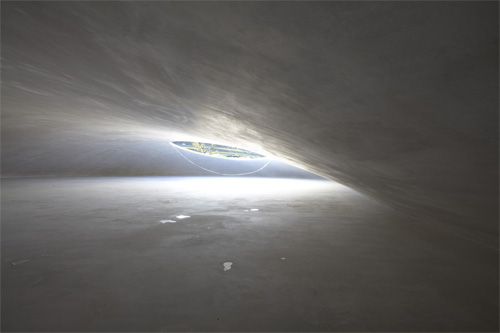
An existing psycho-rigid and introverted house which is just too frustrating too watch in the context of this majestic landscape (Lake of Bourget, with the Mont Blanc in the background, was 'exploded' to become a psycho-liberated and generous.
Extensions may be, therefore, read as a literal deformation of an existing volume to form a sculpture perched on a promontory, proudly stuck between two mountain sides facing the lake with its unexlored depths.




To provide new space and connect the house to its landscape, four interventions were made outside of the existing building. As it is located in middle of the lot, extensions inderectly create characteritsic spaces in what previously was obscure garden residues.

On the west side, a massive horizontal slab suspended on three gracious columns covers a kitchen in continuation with the terrace outside. On the eastern flank, as an extension of the inner universe, a mysterious volume (only with a view to the cliff) accomodates a music room. On the southern side expressive balconies in extention with the main bedrooms reaches for the lake. To finish, the the terrace on the shore side is now excavated to accommodate three big, troglodide shaped bedrooms each one with a view to the lake .

It is a holiday home, there will be nine rooms, nine doors, to be able to leave unnoticed and play.


Project: Construction of four extentions and transformation of an existing house.
Location: Châtillon, Savoie, France
Architecture: V+ (Bihain, Decuypere)
Executing architects: Bihain, Krutejavas
Collaborators: Aidas Krutejavas, Antoine Rocca, Elodie Degrave, Sophie Dars
Engineer: Bollinger + Grohmann Sarl / Klaas De Rycke
Budget: 2.600.000 €
Area: 800 m²
Conception: 2006-2008
Construction: 2009-2010

read more . expandir

Atelier Deshaus

Kindergarten . Jiading New Town


source: Atelier Deshaus . architravel . + archdaily

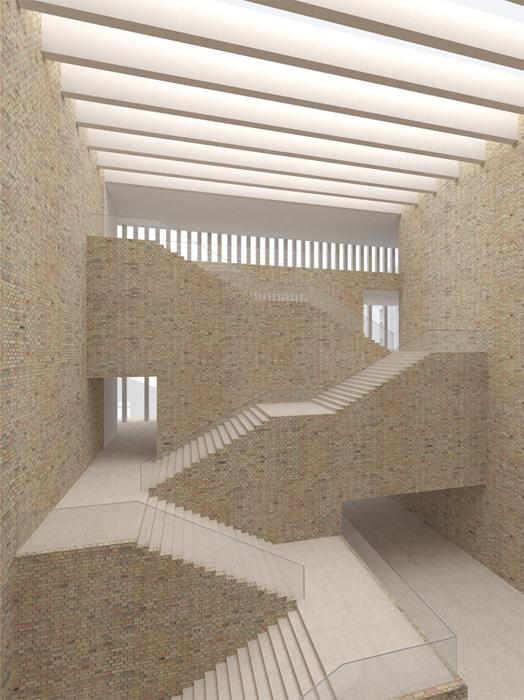
As the kindergarten is located in an open field at the north suburb of Shanghai, this time we choose an unitary and poweful solid standing in the pure situation, different from the strategy to give a couple of detached units we used to.
Different levels of floors make this building dymatic, which also creat the interesting cave space for the outdoor activities where the level changes, arranging the courtyards vertically instead of the traditional horizontal pattern, with the coutyards and childrens’ activities as the part of the façade.
The alternation of different levels also vivifies the interior space. The atrium with the ramp as the main traffic connection provides a spacial experience beyond the daily life, exciting, interesting, novel, creating a brilliant kindgarten full of imagination.
The ambiguity of the space provides the more possibilities to the use of kindgarten.


read more . expandir

faceb

architecture from the other side


source: faceb

read more . expandir

Anne Holtrop

Temporary museum (lake) .  Schone Schijn exhibition


source: Anne Holtrop . Schone Schijn . photo: Bas Princen


read more . expandir

Jean-Christophe QUINTON

Maison P1 . Désert du Kalaharie


source: Jean-Christophe QUINTON

Une inflexion sensible dans un systeme défini : la disparition calculée d'une fenetre organise l'irrégularité de la façade. Le plan se charge d'ordonner une distribution systématisée des ouvertures : chaque piece dispose de deux baies, côte-a-côte ou en vis a vis, suivant les étages. Cette disposition réguliere organise en façade une absence remarquée et en apparence aléatoire de l'ensemble de ses percements.
En accord avec son environement, comme une bâtisse romane, la mise en oeuvre est sommaire, murs épais maçonnés, sol en bois, tous les efforts sont reportés sur l'exécution des menuiseries. Les pieces, toutes de surface identique, sont des alcôves. Elles invitent leurs occupants a une expérience : se tourner le temps du bivouac vers son espace central, se tourner le temps de l'intimité vers le désert.


read more . expandir

:mlzd

Studienauftrag Rehaklinik . Bellikon


source: :mlzd

Die Rehaklinik Bellikon liegt im Reusstal zwischen Zürich und Baden und ist eines von zwei SUVA-Rehabilitationszentren. In den 1970er Jahren wurde die Anlage innerhalb des Südwesthangs auf einem Plateau am Ortsrand des Dorfes Bellikon errichtet. Auf Grund des stetig steigenden Bedarfs soll die Klinik in den nächsten Jahren ausgebaut und erweitert werden.


Die für den Klinikausbau erforderlichen Flächen bringen an dem ländlichen Standort – ähnlich wie beim Bau der Klinik in den 70ern - einen erneuten Massstabssprung mit sich. Ausschlaggebend für die städtebaulichen Überlegungen sind demzufolge die Bezogenheit auf die Landschaft, der Umgang mit dem abrupt abfallenden Terrain sowie die Gliederung der Baumassen unter Berücksichtigung wichtiger Sichtbezüge im Hinblick auf die fantastische Fernsicht bis weit ins Mittelland und die Alpen.

Die Erweiterung der Klinik erfolgt in Form eines flächigen Volumens, das an den Sockel der bestehenden Klinik anschliesst. Die zusammenfassende, rechteckige Kompaktheit des Volumens und dessen Horizontalität geben dem Therapietrakt von nah und fern eine zurückhaltende Eleganz. Leicht über die Hangkante auskragend, präsentiert diese sich als künstlicher Eingriff, der sich mit einer gleichfalls künstlich gestalteten Oberfläche vom umgebenden Landschaftsraum sichtbar abgrenzt.

Ausgehend von den allgemeinen Funktionen im Erdgeschoss teilt sich die bestehende Programmverteilung der Klinik in die Bettentrakte oberhalb und die Therapiefunktionen unterhalb. Dabei werden die Obergeschosse als eine Reihung kubischer Einzelkörper gebildet, die Untergeschosse hingegen gruppieren sich - räumlich invertiert - um geometrische Höfe. Das zwischen beiden Zonen vermittelnde Erdgeschoss ist transparent und lässt einen zwischen Innen und Aussen ‚fliessenden’ Raum enstehen.

read more . expandir

Hideyuki Nakayama

LLOVE exhibition . Tokyo


read more . expandir

ETB

Hospedería de Turismo . Fregenal de la Sierra


origen: gracias a ETB

El sentido de paso del tiempo y la superposición de capas históricas que en Fregenal se percibe en cada rincón. Desde la antigua muralla medieval que se reutilizó de forma eficaz para insertar en el denso tramo urbano la plaza de toros y el mercado medieval, hasta la más sencilla y espontánea modificación del paisaje urbano materializada por los nidos de cigüeña, puede leerse este fenómeno, aproximándose a lo existente de una manera indiferente y poética.  
Los jardines en este contexto parecen tomar un valor añadido enorme, tan monumental como la propria muralla medioval; dentro de una soleada calle blanca de Fregenal en verano, emergen de forma inesperada, a través de un muro blanco de cal, las autenticas "explosiones" de colores de una buganvilla o se observa la alegre danza de unas palmeras batidas por el viento. Dentro de la densidad y homogeneidad del pueblo la naturaleza parece insertarse con una vivacidad aun más fuerte.


Estos jardines producen cambio de color, sonidos, atmósfera en la calle misma, aunque apareciendo solo en parte, detrás de un muro que constituye la privacidad y el misterio propios de la dimensión domestica. Este tipo de elementos más cotidiano y aparentemente banales, pueden ser interpretados como auténticos "monumentos", porque nos hablan de como también detrás de lo espontáneo hay maneras muy elementares de crear lo inesperado, de impresionar al paseante, y agradar al huésped desde el propio espíritu desde el dominio público del pueblo.
En el proyecto para la hospedería de Fregenal, se toma esa segunda vía para construir belleza. Tal como las cigüeñas se apropian con esa espontaneidad de las antiguas torres o de las chimeneas y solo con pocos "tejidos" de ramitas marcan de forma definitiva el skyline del pueblo, de la misma manera resulta conveniente la actuación sobre el antiguo monasterio, dejando una huella sencilla y elemental, capaz de producir emoción por medio de un solo recurso, la naturaleza.
La idea fundamental ha sido concebir un oasis urbano, un espacio vegetal que ocupara la máxima superficie de la parcela y que invadiera le corazón mismo del edificio. Un oasis verde, de palmeras, de naranjos, de magnolias. Un jardín interior mágico, lleno de olores, sonidos, colores, que pueda atraer a pájaros y mariposas, y que pueda rellenar el lugar con una explosión de vida natural dentro de la densidad de los muros y las piedras del casco antiguo. Crear un espacio para el descanso de los ojos y de la mirada, y del resto de sentidos, un jardín lleno de sensualidad y sombra.


JARDIN SECRETO
Concurso Internacional para la nueva Hospedería de Turismo en Fregenal de la Sierra, Badajoz.
Segundo Premio.
Septiembre 2010

AUTORES :
ETB
Alessandro Tessari & Matteo Bandiera (Jefes de proyecto)
German de Pro Lozano, Nicola Di Pietro, Samuele Evolvi.

read more . expandir